Anti-Semitism and the Zeitgeist

Anti-Semitism and the Zeitgeist

Truth Rescued by Time, Witnessed by History by Francisco Goya
1812 – 1814

At the time I came to young womanhood, Jews of my generation believed we were way past the dark days of danger. Only refugees from recent tyrannies spoke of anti-semitism as a force that could show up “even here.”

Well that’s changed, evidently. But before I get to the cure, let’s find out what needs to be cured. Why not trace the trajectory of the thing, going back to its inception. The phenomenon doesn’t start in the Greco-Roman world. In cosmopolitan antiquity, opinions may differ with regard to Jews, but the Jewish presence doesn’t usually prompt dark obsessions.

However, in the first two centuries of the Jesus movement, this changes. As that movement becomes predominantly non-Jewish, a doctrine called “supersessionism” emerges. It holds that Jews used to have a special relationship with God – a covenant – but their covenant was discontinued due to Jews’ perpetual and unanimous bad behavior. As a result, the Jews’ former covenant has now been transferred to the dominant branch of the Jesus movement, based in Rome. Happily, certain restrictions pertaining to the Jewish covenant (like circumcision and dietary limitations), have been abrogated along with that transfer.

As for the still-actual Jews, some Christian thought-leaders (like Ambrose) denied that they retained any rights at all. Others (like Augustine) held that Jews did have a right to live, but only in poverty miserable enough to prove their supersession. (Prove it, I assume, with each rag that failed to warm their shivering bodies.)

This rationale for persecuting Jews prevailed until the modern period, inaugurated by Copernicus, Kepler and Galileo. When Newton solved the theoretical problems that had delayed the acceptance of the new world-view, the eighteenth century’s educated class shaped itself into what became known as the Age of Reason.

As for the Jews, now a modern rationale had to be found for demeaning them. It was determined that Jews sadly lacked the universal vision afforded by Reason. They were backward and narrowly tribal people.

When the Age of Reason gave rise to a reaction in Romanticism, priority went to feeling for one’s locale, love of nature and the people living close to it, deep-delving intuition and creative spontaneity. Accordingly, a new caricature of Jews had to be found. Jews were deemed rootless cosmopolitans.

Do we begin to get the picture? Whatever the Zeitgeist – the spirit of the times – was deemed to be, the Jews would be singled out as its adversary.

When the Nazis recast history in proto-Darwinian terms, as a struggle for dominance between higher and lower races, with theirs the self-described master race, Jews would be rated not merely another among the many “inferior” races. Jews alone would be the toxic race who polluted nature itself as well as society. Six million Jews were murdered with this rationale and the remainder likely would have been had the Nazis not lost the Second World War.

And now, in the post-Nazi period, when racism and dominance of local peoples by colonial powers is at last denounced and decried? What now? Well, Jews along with their ancient nation now restored to its Biblical language and land, have become the preeminent “racists” and of course “colonialists.” What else could they be? 

Once again: to find the Zeitgeist of any era, just identify the terms by which Jews get denounced in that era. Jews will be deemed the anti-Zeitgeist.

As a way of thinking, it’s ungrounded, unfair, mindlessly cruel and unreasonable. Put it on and it will work like trying to see while wearing blinders. Can it be cured? Can the people wearing blinders be persuaded to take them off? Myself, I’ve seen people become anti-semites; I haven’t personally seen anyone cured. It doesn’t act like ordinary prejudice. Nazi philosophers like Martin Heidegger, prominent Hitler-regime deputies like Joseph Goebbels, each had Jewish women in their lives whom they sincerely loved! You can deny the sincerity, but I see no reason to. As a murderous pathology, it seems quite peculiar.

Since it’s focused on Jews, let’s look at that side – at the object of the obsession. Judaism is a historical religion, in fact the most historical one. It makes the claim that God sees us as we think and act in our time. Therefore, if we’ve done the wrong thing, we need to admit it and, if we can, repair it with the person we wronged. Only then is it okay to talk to God about it. We don’t get saved from the human condition. We get repaired by acting appropriately within the human condition – with God’s help obviously.

Why did God “choose the Jews”? God had to make somebody carry out the pilot project of living with God in real time. One foot after another. And the Jews kept the record of how they had acted under their pilot-project assignment. Their preserved record is the Hebrew Bible. Their firstness in carrying out that assignment is a matter of record. It cannot be revoked. All the defamations in the world are powerless to change it. 

If God is an actor in time, along with humankind, some people must provide the first case of that assignment and provide the record. Without that, we have only the God-of-nature or of supernature. We don’t have the God of ourselves – of just who and where we actually are.

For Jews, Adam’s disobedience doesn’t plunge humanity into a state of sinfulness that’s incurable. The Hebrew record shows that human beings can sin, like Cain, or not sin, like Abel. Nor does the Hebrew Bible reference Adam again, after the fifth chapter of Genesis. I doubt Jesus references Adam in any of the four gospels. So far as I recall, the doctrine of Original Sin first appears in Paul’s epistles. So the Pauline interpretation of the crucifixion of Jesus, as effecting humankind’s redemption from Original Sin, solves a problem not familiar to the Jewish experience of human redemption.

So what, finally, is anti-semitism? And why does it go on from era to era, under different disguises in keeping with the era, but just as incurable in each era?

It is the bitterly rancorous belief that God really does prefer the Jews, that the covenant God made with the Jews is not superseded. And with it the concomitant belief that the brother who feels less loved can get to be preferred if he defames, desecrates and erases Jewish existence finally and forever. 

Friends, fellow siblings, it’s an obvious mistake. It’s kid stuff. Nothing and no one can erase Jewish firstness in recognizing, interacting with, and keeping the record of human interactions with the God of history. But nothing has to erase it. The historical record bars no one from knowing, loving and serving God in their own way.

Cain was mistaken in killing Abel. 

It gained him nothing.


Related Content: Anti-Semitism’s Secret Springs

Posted in Absolute Freedom and Terror, absurdism, academe, action, afterlife, agnosticism, alienation, American politics, anthropology, anti-semitism, appreciation, art, art of living, atheism, authenticity, autonomy, bad faith, beauty, Bible, Biblical God, bigotry, books, bureaucracy, childhood, chivalry, Christianity, cities, class, conformism, contemplation, contradictions, cool, courage, courtship, cults, cultural politics, culture, desire, dialectic, erotic life, eternity, ethics, ethnicity, evil, existentialism, exploitation, faith, fashion, fatherhood, female power, femininity, feminism, filial piety, films, freedom, friendship, gender balance, glitterati, Gnosticism, guilt and innocence, health, Hegel, hegemony, heroes, hidden God, hierarchy, history, history of ideas, id, idealism, ideality, identity, ideology, idolatry, immorality, immortality, Industrial Revolution, institutional power, Jesus, Jews, journalism, Judaism, law, legal responsibility, life and death struggle, literature, love, male power, martyrdom, masculinity, master, master/slave relation, medieval, memoir, memory, Messianic Age, mind control, modern women, modernism, moral action, moral evaluation, moral psychology, morality, mortality, motherhood, mysticism, Nihilism, nineteenth-century, non-violence, novels, ontology, oppression, pacifism, past and future, peace, Phenomenology of the Mind, philosophy, poetry, political, political movements, politics, politics of ideas, postmodernism, power, power games, presence, promissory notes, propaganda, psychology, public facade, public intellectual, race, racism, radicalism, reading, reductionism, relationships, religion, remembrance, repairing the culture, roles, romance, romantic love, romanticism, science, scientism, secular, seduction, self-deception, seventeenth century, sex appeal, sexuality, slave, social climbing, social construction, social conventions, social ranking, sociobiology, spiritual journey, spiritual not religious, spirituality, status, status of women, suffering, terror, terrorism, the examined life, the problematic of men, the problematic of woman, the profane, the sacred, theism, theology, time, Truth, TV, twentieth century, twenty-first century, Utopia, victimhood, victims, violence, war, work, writing, Zeitgeist | Tagged , , , , , , , , , , , , , , , , , , , , , , , , , , , , , , , , , , , , , , , , , , , , , , , , , , , , , , , , , , , , , , , , , , , , , , , , , , , , , , , , , | 1 Comment

Beautiful Souls and Life on the Ground


Adams Memorial by Augustus Saint-Gaudens 1891
Photo by David

We are back in Bucks County and home from a conference in San Diego where we each presented our just-published books. The title of mine, as was noted last week, is Confessions of a Young Philosopher and it’s a life work. The meeting where we spoke was one of several in a group called Theology Without Walls under the broader auspices of the American Academy of Religion.

Jerry and I formed part of a five-member panel where the authors spoke in turn about each of five new books. The books form a series whose only common element is that each one navigates the relation between the human situation and the Ultimate, without at the outset defining that relation in terms approved by any of the established religions. Though they might end up in an established religion, the writers don’t begin there. At least at the start, their human search is wide open.

I was pretty nervous, talking about my book to this audience of theologians. It tells a true story, one that took place in my twenties, the first decade of adult life, a story that people who came to know me later didn’t know – because I didn’t talk about it! Doesn’t Descartes (the 17th century philosopher) say somewhere, “Henceforth I will appear on stage the way an actor does – masked”? Well, I wasn’t exactly masked (wasn’t wearing a false face) but I wasn’t fully disclosed either.

In consequence, I was in a rather upset state inwardly as I gave my presentation, and couldn’t see that (as was later reported to me) the audience was gripped by it, applauding with enthusiasm at the end. Afterward, one professor from Africa told me that he planned to assign Confessions to his students as required reading. Another listener, a multi-talented, multiply-published theologian, came up to tell me that my paper led him to take more seriously the Socratic life strategy of living out one’s beliefs insofar as one takes them to be true.

*. *. *

There was, however, one set of views that I hold but did not live out during the three-day theological conference. Those would be the cluster of historically-grounded views supporting my overarching belief that it is right and proper for the Jewish people to defend the Jewish state, to defend Israel. Rightly or wrongly, I supposed the assembled attendees to be mostly people of a certain type. Let me describe the kind of person I had in mind.

It’s a human type whom the German novelist, poet, playwright, and natural philosopher Johann Wolfgang von Goethe (1749-1832) introduced to the reading public in his Sorrows of Young Werther under the category of the Beautiful Soul. Such persons can be counted on to look ever upwards – toward the ideal, the pure, and the lofty. At the gritty pavement on which they stand, they don’t look quite so much.

In a contrasting mindset – honed and shaped by approximately 1800 years of defamation and violent persecution culminating in the Holocaust – the Jewish people concluded in 1948 that it was time to make their longed-for political restoration actual, in a state having defensible boundaries and an army to defend it. Assuredly, their resolve did include beautiful dreams, but it was not born of such dreams. It was actualized with the U.N. vote for partition in 1948, and by beating back the invasion by five Arab states that together had rejected the U.N. resolution. It was only realized when all the other alternatives had been thoroughly exhausted. “Where were we supposed to go?” as one concentration camp survivor said to me: “the North Sea?”

When Israel voluntarily pulled its settlers out of Gaza in 2005, Gazans voted to be governed by Hamas. The founding charter of Hamas calls for the murder of every Jew on the planet. The boastful massacres of October 7, 2023, together with its gleeful tortures and sadistic kidnappings, were perpetrated by Hamas, whose operatives photographed the carnage they had wrought and promised repetitions without limit. In Gaza, Hamas operatives have been encamped in approximately 300 miles of tunnels, with arms stored under schools, hospitals and apartment houses. When the Israel Defense Forces go after Hamas, trying – to a degree unprecedented in modern warfare – to give civilians advance warning and time to escape, the results can still be tragic in those Hamas-crafted circumstances. But disempowering such an enemy is what any state so attacked would have to do.

There were a couple of moments during the conference when one Beautiful Soul or another let me know that their sights were set far higher than the IDF’s earth-bound sights. Meantime, though many world religions were referenced in fine and varied presentations, I did not hear Judaism mentioned. Except once, when I mentioned it in the context of a particular Q & A. The usual religious groupings would be “Christianity, Islam” and uh … Buddhism, Hinduism or Confucianism!

So I guess Jesus had it wrong when, strange as it seems, he actually said –

salvation is of the Jews.

When you don’t acknowledge a presence, you’re less likely to notice an absence. Conceptual erasure opens the way to physical erasure.

The Beautiful Souls want to start doing theology with a clean slate. But without looking down long enough to notice that –

there may be Jewish blood

on their clean slate.


Related Content: The Color of the Sky

Posted in Absolute Freedom and Terror, absurdism, academe, action, afterlife, agnosticism, alienation, American politics, anthropology, anti-semitism, appreciation, art, art of living, atheism, authenticity, autonomy, bad faith, beauty, Bible, Biblical God, bigotry, book reviews, books, bureaucracy, childhood, chivalry, Christianity, cities, class, conformism, contemplation, contradictions, cool, courage, courtship, cults, cultural politics, culture, desire, dialectic, eighteenth century, erotic life, eternity, ethics, ethnicity, evil, existentialism, exploitation, faith, fashion, fatherhood, female power, femininity, feminism, filial piety, films, freedom, friendship, gender balance, glitterati, Gnosticism, guilt and innocence, health, Hegel, hegemony, heroes, hidden God, hierarchy, history, history of ideas, id, idealism, ideality, identity, ideology, idolatry, immorality, immortality, institutional power, Jesus, Jews, journalism, Judaism, law, legal responsibility, life and death struggle, literature, love, male power, martyrdom, masculinity, master, master/slave relation, medieval, memoir, memory, Messianic Age, mind control, modern women, modernism, moral action, moral evaluation, moral psychology, morality, mortality, motherhood, mysticism, Nihilism, nineteenth-century, non-violence, novels, ontology, oppression, pacifism, past and future, peace, Phenomenology of the Mind, philosophy, poetry, political, political movements, politics, politics of ideas, postmodernism, power, power games, presence, promissory notes, propaganda, psychology, public facade, public intellectual, race, racism, radicalism, reading, reductionism, relationships, religion, remembrance, repairing the culture, roles, romance, romantic love, romanticism, science, scientism, secular, seduction, self-deception, sex appeal, sexuality, slave, social climbing, social construction, social conventions, social ranking, sociobiology, spiritual journey, spiritual not religious, spirituality, status, status of women, suffering, terror, terrorism, the examined life, the problematic of men, the problematic of woman, the profane, the sacred, theism, theology, time, Truth, TV, twentieth century, twenty-first century, Utopia, victimhood, victims, violence, war, work, writing, Zeitgeist | Tagged , , , , , , , , , , , , , , , , , , , , , , , , , , , , , , , , , , , , , , , , , , , , , , , , , , , , , , , , , , , , , , , , , , , , , , , , | Leave a comment

Confessions of a Young Philosopher: A Special Feature

I wanted to be conscious of the purposes behind my choices, not let them guide me unawares. It was a point of honor not to profess views if I was not prepared to put them to the test of living them.


With these words, Pulitzer-nominated author Abigail L. Rosenthal sets the tone for Confessions of a Young Philosopher, her groundbreaking memoir. Blending philosophical reflection, and a deeply personal narrative with illustrations by Caroline Church, Confessions is an intimate exploration of a life lived with purpose, courage, and unrelenting curiosity.

Asked how long she’s been writing Confessions, Abigail says it’s been a lifetime. And indeed each chapter is the culmination of years spent grappling with life’s biggest questions—testing ideas, reflecting on choices, and distilling wisdom from raw experience.


A Life Examined

Born in Manhattan to “interesting parents,” profoundly shaped by the shadow of the Holocaust. Abigail’s intellectual and emotional journey begins in Paris on a Fulbright grant. Beyond academic trophies, she was pursuing meaning.

This memoir chronicles the writer’s determination to live with authenticity and integrity, even when the world demanded compromise. Questions of identity, love, truth and the choices that shape us are examined, unearthing insights that resonate beyond the writer’s own life.


Tackling the Timeless and the Timely

Explored in Confessions of a Young Philosopher:

  • Gender and societal expectations
  • The search for meaning
  • Anti-humanism and identity politics
  • The enduring scourge of anti-Semitism

In Confessions, these are not abstract questions. They are illustrated as they intersect with Abigail’s journey. Philosophical principles are tested by living them.


A Book Critics Can’t Ignore

Readers have hailed Confessions of a Young Philosopher as a profound and courageous work:

  • “Since the Enlightenment, a number of people have tried to tell the truth about their own lives … Boswell, Rousseau, Stendahl, Celine—are there other women who have tried to do the same? I suppose Augustine was a pioneer … I think what [Abigail L. Rosenthal] has done is a most splendid and courageous addition to the literature of trying to tell the truth about oneself.” — David M. Armstrong, Author, Sketch for a Systematic Metaphysics (2010) and Truth and Truthmakers (2004).

  • “This powerful book will gradually make its way into Bildungsroman-like permanence.” — Cynthia Ozick, Author, Antiquities (2021) and Critics, Monsters, Fanatics, and Other Literary Essays (2016).

  • “In this remarkable and deeply instructive book, a gifted woman philosopher records and criticizes her youthful attempt, as strenuously lived as it is argued, to frame a path through life capable of engaging her talents without denying or distorting her female identity. She explores to the limits of liveability a string of contemporary world-views ranging from romantic love in the French literary manner, by way of Marxist/Castroist political commitment, to a disastrous engagement with a charismatic advocate of ‘Christian Gnosticism.’… Profoundly philosophical as her argument is, Rosenthal writes with a vigor and liveliness that owe little to the drowsy circumlocutions of much academic prose. The book is a page-turner.” — Bernard Harrison, Author, Blaming the Jews: Politics and Delusion (2020) and What is Fiction For? Literary Humanism Restored (2015).

A Gift of Wisdom for Readers

In a seamless blend of storytelling and philosophical inquiry, Confessions of a Young Philosopher is for any reader yearning to think deeply, live authentically, and face life’s complexities with clarity and courage.

Join this extraordinary journey. Copies can be ordered at amazon.


Related Content

Confessions of a Young Philosopher | Colliding with the Book I Wrote

Posted in Absolute Freedom and Terror, absurdism, academe, action, afterlife, agnosticism, alienation, American politics, anthropology, anti-semitism, appreciation, art, art of living, atheism, authenticity, autonomy, bad faith, beauty, Bible, Biblical God, bigotry, books, childhood, chivalry, Christianity, cities, class, conformism, contemplation, contradictions, cool, courage, courtship, cults, cultural politics, culture, desire, dialectic, erotic life, eternity, ethics, ethnicity, evil, existentialism, exploitation, faith, fashion, female power, femininity, feminism, filial piety, films, freedom, friendship, gender balance, glitterati, Gnosticism, guilt and innocence, health, Hegel, hegemony, heroes, hidden God, hierarchy, history, history of ideas, id, idealism, ideality, identity, ideology, idolatry, immorality, immortality, institutional power, Jesus, Jews, journalism, Judaism, law, legal responsibility, life and death struggle, literature, love, male power, martyrdom, masculinity, master, master/slave relation, memoir, memory, Messianic Age, mind control, modern women, modernism, moral action, moral evaluation, moral psychology, morality, mortality, mysticism, Nihilism, nineteenth-century, non-violence, novels, ontology, oppression, pacifism, past and future, peace, Phenomenology of the Mind, philosophy, poetry, political, political movements, politics, politics of ideas, postmodernism, power, power games, presence, promissory notes, propaganda, psychology, public facade, public intellectual, race, racism, radicalism, reading, reductionism, relationships, religion, remembrance, repairing the culture, roles, romance, romantic love, romanticism, science, scientism, secular, seduction, self-deception, sex appeal, sexuality, slave, social climbing, social construction, social conventions, social ranking, sociobiology, spiritual journey, spiritual not religious, spirituality, status, status of women, suffering, terror, terrorism, the examined life, the problematic of men, the problematic of woman, the profane, the sacred, theism, theology, time, Truth, TV, twentieth century, twenty-first century, Utopia, victimhood, victims, violence, war, work, writing, Zeitgeist | Tagged | Leave a comment

Anti-Semites I Have Known

Anti-Semites I Have Known
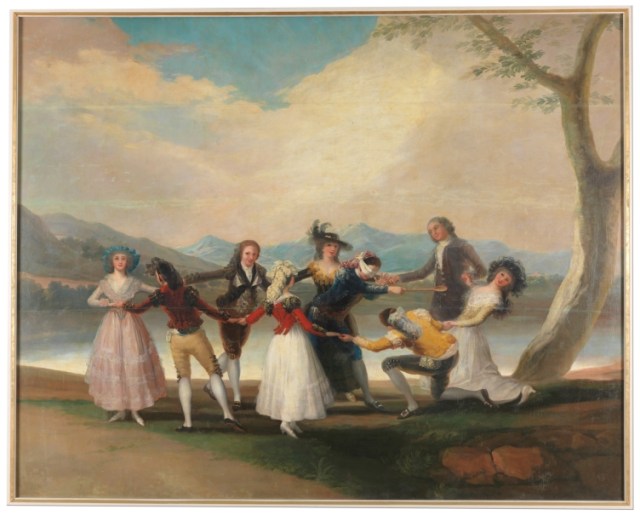
Blind Man’s Bluff
Francisco Goya, 1788

Actually, I haven’t known that many. I’m talking about people who directed offensive remarks at me personally, related to my being Jewish, with intent to hurt. (As to the current variety, who sport masks, they came on scene after I’d left the academy and I can only say that I’m glad I’m not their mother.)

The first was a man with whom Jerry had been friends since graduate school. He’d been a witness at our wedding. He was a priest, at first Roman Catholic but, at the time of this recollection, Russian Orthodox. Since I have a tendency (possibly naïve) to trust men of the cloth – taking them to have deliberately chosen a life with God as their witness – I never felt his vocation as a barrier.

Anyway, not long after we’d gotten married, Jerry and I met this friend for dinner at a restaurant. We were expecting to enjoy a pleasant reunion.

When you meet a trusted friend socially, normally you don’t have an agenda. The fun lies partly in finding out how the conversation unfolds in an unplanned way. So I was surprised to see him bring up modern Israel as the topic to which he’d be dedicating our time together and still more amazed to see him steer the conversation toward a loaded (“have you or have you not stopped beating your wife?”) Israel-baiting question.

I answered in a way that aimed to smooth down the edges of his loaded question. The situation itself had taken me unawares.

It hadn’t taken him by surprise, for he said instantly, “It’s no use talking about this with – an American Jew!

Historical note: I am clearly a member of the tribe of Jehudah, of which “Jew” is a contraction. You may recall that Jesus said, “salvation is of the Jehudim.” Out of the original twelve tribes of Israel, Jehudah is the only one that survived politically, with Benjamin folded into it. However, my tribal origins aren’t a certainty, since individuals and families from other tribes must have attached themselves to Jehudah after the other ten had been carried off and therefore officially “lost” or dispersed.

Social note: the contraction “Jew” is generally avoided in direct discourse, since one-syllable words sound at least over-familiar or at worst insulting. That’s why polite people will tend to say, “Are you Jewish?” rather than “Say, aren’t you a Jew?” But that’s all I have to report. The further history of the contraction I leave to specialists.

Now back to our three-way dinner at the restaurant. I’ve never known how I should have answered Jerry’s priestly friend. In the moment, what I actually said was … three notes from the bugle … 

Nothing!

What a flop! Feminists all over the world are making faces of disgust. I too can’t approve my silence. So what was I thinking? Why didn’t I fight back?

I may have sensed that the insult to me had been aimed at Jerry, but indirectly. Jerry had recently told his priestly friend of having had a religious experience that took Jerry from lifelong agnosticism to faith. At an earlier time, the friend had once confided to Jerry that he suffered deep doubts – is “God” just a projection? – while outwardly continuing to play the part of priest, like an actor on the stage. So it might be that the priest had chosen this rather contemptible way to end the friendship and thereby avoid disquieting comparisons.

Perhaps I sensed that some murky evasions lay back of the aggression outwardly aimed at me. Before you get into a fight, you want to know where your target is to be found. Also, I had an intuitive reluctance to provoke two men into a fight with a woman in the middle.

So I kept silent and, after a pause, retreated to the women’s room. In my absence they had continued chatting though Jerry later raised objections to his conduct via email. On his side he drove the wedge deeper and … we never met again. If that had been the aim, Jerry’s ex-friend the priest achieved it.

Sad, eh?

My second example occurred at an academic conference devoted to the French Jewish philosopher Emmanuel Levinas. It was held at the University of Chicago, with many panels and a large attendance. To my amazement, most panelists stepped around the fact that Levinas wrote as a committed and believing Jew, who argued openly for the relevance and precision of the Jewish understanding of human reality, at the same time openly contesting the Christian alternative views. Of course, that’s what philosophers do, but – given two thousand years of Christian supersessionist doctrine – this plain invitation from Levinas to his counterparts to duke it out in the open like philosophers took great moral and intellectual courage. At the U of Chicago conference, what panelists seemed to want was to savor Levinas’s conclusions without climbing the intellectual ladder he’d provided to get there.

I found the whole event pretty strange, but only offered a counter-argument privately to one panelist after he’d stepped off the stage. To him I reviewed the longer 20th century chronology that I believed would put his conclusory anti-Israel remarks in a relevant context.

How did this panelist respond? He told me that my remarks were evidence of certain defects, moral, emotional and psychological, that were visible –

on my face!

Now Levinas writes a lot about the human face and the obligation it places on people to see the face of the other and respond to it with ample recognition and responsibility. So his use of that term as an insult was remarkable in a Levinasian context. But with or without Levinas, there’s probably no woman on the planet who wouldn’t feel the insult of what this man said.

It was an erotic erasure.

I’m a pretty sensitive girl. To me, it felt like an earthquake. When I reported the incident to Catherine Chalier, the person at that conference personally and philosophically closest to Levinas, I asked her, 

     “Was there something I should have said?”

     “No,” she responded. “It’s hatred. And it’s hopeless.”

There is a chivalry of human relations and it is to be respected. This man had disrespected that chivalry. When, at the finale of his Divine Comedy, Dante writes of love that it “moves the sun and the other stars,” 

I think he means

chivalric love.


Related Content: Where’d My World Go?

Posted in Absolute Freedom and Terror, absurdism, academe, action, afterlife, agnosticism, alienation, American politics, anthropology, anti-semitism, appreciation, art, art of living, atheism, authenticity, autonomy, bad faith, beauty, Bible, Biblical God, bigotry, books, bureaucracy, chivalry, Christianity, cities, class, conformism, contemplation, contradictions, cool, courage, courtship, cults, cultural politics, culture, desire, dialectic, erotic life, eternity, ethics, ethnicity, evil, existentialism, exploitation, faith, fashion, fatherhood, female power, femininity, feminism, filial piety, freedom, friendship, gender balance, glitterati, Gnosticism, guilt and innocence, health, Hegel, hegemony, heroes, hidden God, hierarchy, history, history of ideas, id, idealism, ideality, identity, ideology, idolatry, immorality, immortality, institutional power, Jesus, Jews, journalism, Judaism, law, legal responsibility, life and death struggle, literature, love, male power, martyrdom, masculinity, master, master/slave relation, medieval, memoir, memory, Messianic Age, mind control, modern women, modernism, moral action, moral evaluation, moral psychology, morality, mortality, motherhood, mysticism, Nihilism, nineteenth-century, non-violence, novels, ontology, oppression, pacifism, past and future, peace, Phenomenology of the Mind, philosophy, poetry, political, political movements, politics, politics of ideas, postmodernism, power, power games, presence, promissory notes, propaganda, psychology, public facade, public intellectual, race, racism, radicalism, reading, reductionism, relationships, religion, remembrance, repairing the culture, roles, romance, romantic love, romanticism, science, scientism, secular, seduction, self-deception, sex appeal, sexuality, slave, social climbing, social construction, social conventions, social ranking, sociobiology, spiritual journey, spiritual not religious, spirituality, status, status of women, suffering, terror, terrorism, the examined life, the problematic of men, the problematic of woman, the profane, the sacred, theism, theology, time, Truth, TV, twentieth century, twenty-first century, Utopia, victimhood, victims, violence, war, work, writing, Zeitgeist | Tagged , , , , , , , , , , , , , , , , , , , , , , , , , , , , , , , , , , , , , , , , , , , , , , , , , , , , , , , , , , , , , , , , , , , , , , , , , , , , , , , , , , , , , , , | Leave a comment

The Election Has Taken Place

The Election Has Taken Place

In these columns, I’ve preferred to stay clear of the politics of the day. It’s been my experience that honest people do differ, and sometimes even over the most vital issues. I haven’t wanted to use “Dear Abbie” to acquire a single-outlook or solely partisan readership. After all, political preferences tend to be guided by the news sources a person consults. Which puts political opinions in a different category from the ones at stake in philosophical argument. There, at least ideally, the argument is over how to interpret the same body of evidence.

That said, the American election of the previous week was so very consequential that avoidance of the topic here would be simply evasive. So full disclosure: 

I voted for the loser.

Among the people I respect and like – whether known to me personally or only through their books and articles – votes have gone to both sides. (My taste in my fallible fellow mortals is pretty ecumenical.)

Oddly, if I polled opposing groups of voters for their reasons, the reasons on both sides might be ones with which I’m in sympathy! Some of the Trump voters just didn’t want guys in women’s sports, jail cells and bathrooms. Personally, I don’t want ‘em in there either. Some Trump voters didn’t want irreversible sex change surgery plus hormone treatments performed on minors. As it happens, I’ve known two young people who committed suicide after undergoing sex change surgery – each discovering too late that the problem wasn’t that they’d been born in a body of the wrong sex. Rather, they’d been hastily and wrongly advised by supposed experts who held the latest and most fashionable views. I could go on, but you get the idea.

Although I think Harris deserves credit for putting up a fine fight in a difficult season, what most moved me to pull the lever for her was Trump himself. He’s the man I saw telling the mob – who’d invaded the Capital calling for the lynching of the Vice President – “I love you! This day will live forever!” As a candidate, he’s expressed admiration for a number of foreign dictators. He’s been convicted by a New York jury of defaming a woman whom he falsely denied raping. I’ve seen him use vile and degrading language about a woman reporter who questioned him in a way not different from the way she had questioned others before him. People who worked closely with him have deemed him a danger to the republic, even risking their careers by testifying under oath to that effect. His opinions about international relations and the economy seem impulsive and ill-informed. 

While two thirds of Israelis polled have reason to believe that he’d be better for besieged Israel than his opponent (Trump’s Jewish daughter may prompt him to see the Jewish state as an extension of himself), I believe Israel would find a way to survive even under an ambivalent Democratic administration. Whereas an America friendly to dictators would soon become dangerous for Israel, Ukraine, and democracies everywhere.

Late note: I’ve just watched Bob Woodward, who’s interviewed him extensively, express the hope and belief that – with an eye on his place in history – Trump might still grow in office and pleasantly surprise those who now fear his return to office.

For me, the overriding consideration has been that Trump appears more likely to disrespect the rule of law than any previous president in American history. It’s one of the most consequential elections we’ve held since the founding of the republic. For us all, 

the results are
still to be determined.


Related Content: Passionate Intensity

Posted in Absolute Freedom and Terror, absurdism, academe, action, afterlife, agnosticism, alienation, American politics, anthropology, anti-semitism, appreciation, art of living, atheism, authenticity, autonomy, bad faith, Biblical God, bigotry, book reviews, books, bureaucracy, childhood, chivalry, Christianity, cities, class, conformism, contemplation, contradictions, cool, courage, courtship, cults, cultural politics, culture, desire, dialectic, erotic life, eternity, ethics, ethnicity, evil, existentialism, exploitation, faith, fashion, fatherhood, female power, femininity, feminism, filial piety, films, freedom, friendship, gender balance, glitterati, Gnosticism, guilt and innocence, health, Hegel, hegemony, heroes, hidden God, hierarchy, history, history of ideas, id, idealism, ideality, identity, ideology, idolatry, immorality, immortality, institutional power, Jesus, Jews, journalism, Judaism, law, legal responsibility, life and death struggle, literature, love, male power, martyrdom, masculinity, master, master/slave relation, memoir, memory, Messianic Age, mind control, modern women, modernism, moral action, moral evaluation, moral psychology, morality, mortality, Nihilism, nineteenth-century, non-violence, novels, ontology, oppression, pacifism, past and future, peace, Phenomenology of the Mind, philosophy, poetry, political, political movements, politics, politics of ideas, postmodernism, power, power games, presence, promissory notes, propaganda, psychology, public facade, public intellectual, race, racism, radicalism, reading, reductionism, relationships, religion, remembrance, repairing the culture, roles, romance, romantic love, scientism, secular, seduction, self-deception, sex appeal, sexuality, slave, social climbing, social construction, social conventions, social ranking, sociobiology, spiritual journey, spiritual not religious, spirituality, status, status of women, suffering, terror, terrorism, the examined life, the problematic of men, the problematic of woman, the profane, the sacred, theism, theology, time, Truth, TV, twentieth century, twenty-first century, Utopia, victimhood, victims, violence, war, work, writing, Zeitgeist | Tagged , , , , , , , , , , , , , , , , , , , , , , , , , , , , , , , , , , , , , , , , , , , , , , , , , , , , , , , , , , | Leave a comment

The Owl of Minerva Takes Flight Again

Owl of Minerva
L’appel des dernières victimes de la Terreur à la prison Saint Lazare le 7 thermidor an II
Calling Out the Last Victims of the Terror at Saint Lazare Prison on the 7-9 Thermidor 1794
by Charles Luis Müller c. 1845

This is being written the last Sunday evening before our national election. By the time it’s posted, tabulation of ballots will be under way, perhaps disclosing which way the political winds are now blowing. However, as Hegel wrote:

The owl of Minerva

takes flight

only at dusk.

He meant that philosophers are not in a position to produce political forecasts. But that constraint doesn’t preclude them from attempting to read the spirit of the times – especially insofar as philosophy has its own part to play in the Zeitgeist.

So here I am, climbing on the Owl’s feathery back (she’s the pet bird of Minerva, the goddess of wisdom) to report whatever I can see that stands out in the cultural landscape.

I’ve been advised by a reliable philosopher friend that post-modernism has peaked and is now looking a bit tired, somewhat yesterday. So far as I could see, it had not penetrated academic philosophy very deeply, though it had affected other liberal arts or humanistic fields such as literature and art history, the social sciences and even psychology.

What sort of influence did it have? What was it telling us? It’s a form of skepticism. But unlike the more traditional efforts in that genre, post-modernism did not so much refute particular claims of knowledge as disclaim any need to rely on evidence or logic – even for the purpose of refutation! Rather, refutation and whatever is supposedly refuted stand on an equal footing. Both are feats of rhetoric – thus exercises in persuasion. No data from the external world – outside the domain of speech and counter-speech – can be admitted to refute a claim. Nor can logic be admitted for its usual purpose of exposing a contradiction. I contradict myself, you say? And I say, So what! Leave us alone man, we’re dancing – and we’re not doing that refuting dance.

Is nothing in postmodernism serious? Does it all come down to mere to-ing and fro-ing? No certainly not, but the hard edges will have to be imported from the political domain. Antonio Gramsci (1891-1937) in his Prison Notebooks (1929-1935) lifts the whole dance above the level of pleasurable diversion. For Gramsci, the exercise of freeing humanistic source materials and methods from evidential constraints can serve his desired political purpose. In his view, the liberal arts support the culture – while the culture in turn provides a rationale for regimes of Oppression. Accordingly, he urges his readers to infiltrate the liberal arts as well as the professions they staff and service. Once taken over, these disciplines can be remade into instruments for the exposure of the regimes of Oppression. In sum, postmodernism’s purported indifference to knowledge claims can assist a Gramscian takeover of cultural and political power.

So post-modernism may be going out of style, but the Gramscian agenda it serves has not gone out of style. Anyone working in a humanistic discipline knows that one risks denunciation as an Oppressor if one deviates from whatever opinions or opinion shapers are approved at the moment. So the latest variant on what became known during the French Revolution as a Reign of Terror is still “on” – though a measure of muttered weariness with its arbitrary cruelties is getting more audible.

So what does all this stormy agitation look like, to a person flying overhead on the feathery back of Minerva’s Owl? As soon as a cultural movement openly refuses rational evaluation, it loses its purported relevance for philosophy. What I’ve delineated is the desert landscape of total intellectual emptiness. Mental stasis. Evaluative capacities at full stop.

From a Hegelian standpoint, that does not signal that there are no more real and consequential thoughts to think nor any inspired and productive and intellectual leadings to work out. More likely, what the Owl has spotted is intellectual exhaustion with resultant aridity at the surface of the culture. On a deeper level, the likelihood is that

new hypotheses and

path-breaking explorations

are dawning.


Related Content: Times Best and Worst | Philosophy and Me

Posted in Absolute Freedom and Terror, absurdism, academe, action, afterlife, agnosticism, alienation, American politics, anthropology, anti-semitism, appreciation, art, art of living, atheism, authenticity, autonomy, bad faith, beauty, Biblical God, bigotry, books, bureaucracy, chivalry, Christianity, cities, class, conformism, contemplation, contradictions, cool, courage, courtship, cults, cultural politics, culture, desire, dialectic, erotic life, eternity, ethics, ethnicity, evil, existentialism, exploitation, faith, fashion, female power, femininity, feminism, filial piety, films, freedom, friendship, gender balance, glitterati, Gnosticism, guilt and innocence, health, Hegel, hegemony, heroes, hidden God, hierarchy, history, history of ideas, id, idealism, ideality, identity, ideology, idolatry, immorality, immortality, institutional power, Jesus, Jews, journalism, Judaism, law, legal responsibility, life and death struggle, literature, love, male power, martyrdom, masculinity, master, master/slave relation, memoir, memory, Messianic Age, mind control, modern women, modernism, moral action, moral evaluation, moral psychology, morality, mortality, motherhood, mysticism, Nihilism, nineteenth-century, non-violence, novels, ontology, oppression, pacifism, past and future, peace, Phenomenology of the Mind, philosophy, poetry, political, political movements, politics, politics of ideas, postmodernism, power, power games, presence, promissory notes, propaganda, psychology, public facade, public intellectual, race, racism, radicalism, reading, reductionism, relationships, religion, remembrance, repairing the culture, roles, romance, romantic love, romanticism, science, scientism, secular, seduction, self-deception, sex appeal, sexuality, slave, social climbing, social construction, social conventions, social ranking, sociobiology, spiritual journey, spiritual not religious, spirituality, status, status of women, suffering, terror, terrorism, the examined life, the problematic of men, the problematic of woman, the profane, the sacred, theism, theology, time, Truth, TV, twentieth century, twenty-first century, Utopia, victimhood, victims, violence, war, work, writing, Zeitgeist | Tagged , , , , , , , , , , , , , , , , , , , , , , , , , , , , , , , , , , , , , , , , , , , , , , | 2 Comments

Philosophers’ Lives: As Told and Untold

Philosophers’ Lives: As Told and Untold

Detail from Raphael’s The School of Athens, 1510.

Recently, I’ve been going through back issues of Proceedings and Addresses, the official publication of the American Philosophical Association. A given issue will contain programs and announcements for the current meetings, and Memorial Minutes, which of course means obituaries for colleagues recently deceased. I’ve been saving some of the obits and discarding the rest of the rest of the back issues. 

In the process, I’ve read some of these farewells for the first time, including writeups of people I didn’t know had died. Some of the eulogies brought to mind what my father’s cousin Ethel had said about the flowery flattery at one such putting-to-rest event she attended:

I wanted to pick up the lid to see

if I was at the right funeral.

I found one colleague, of whose death I hadn’t heard, extolled to the highest heaven by two other colleagues. There isn’t one member of the mutually congratulatory threesome who I would ask to hold my watch while I took a shower. But there were the two survivors, describing the colleague who has now left us: What a paragon! Such a privilege to have lived when he was alive!

Well, I’m sure glad they didn’t ask me to write the obit. He’d been deployed, at one point during my seven-year job struggle, to evaluate my teaching hour. After observing my class, he’d suggested that we get together for dinner. With apparent appreciation, he listened as I discussed my overall approach to teaching philosophy. The next time we met, it was at the follow-up conference with the chairperson. Turned out, he guessed that my confidences at dinner would resemble things I would also say at the follow-up conference. So he had his ready-made rebuttals all prepared. It was the equivalent of a sucker punch: with an inviting smile, you draw your target in close enough so that your fist gets at the wide-open and unguarded middle directly. 

I turn now to the fulsome Memorial Minute for a Fearless Feminist. Let’s call her Janet. Before I joined the Department, Janet had prompted two other women colleagues to invite me to meet them all for lunch, because “the women of the Department” wanted to get together with me separately from my official interview. During the lunch, no one laid out for me specific cases where faculty or student women had been treated unfairly. Generic unfairness was simply assumed. Well, I did not like to have my support enlisted before I knew what the issues were. 

Janet asserted that the bloc she opposed (the ones who’d conducted my official interview) would expect me to be their lackey. I responded that they’d be disappointed because I’m nobody’s lackey. She of course interpreted me to be saying that I would be hers.

Later, unsurprisingly, it turned out that the support she expected did not concern any issues I could identify as significant to women. Her expectation had been a lot simpler than that: merely that I would vote for her bloc in a divided Department. When for unrelated reasons I did not turn out to vote her way, she became a bitter and dedicated enemy.

Eventually, after my seven-year job struggle, in which she figured in certain key and colorful episodes, I was reinstated with tenure. It was during my first days back at the college that Janet spotted me having lunch in the faculty cafeteria. She walked over to my table to tell me sincerely –

You deserve tenure in hell!

I’m not that great at pithy rejoinders, so here’s all I could think of:

Janet!  That’s a terrible thing to say!

Pretty lame, eh?

There was one obit I clipped where I will use the real name: that of my friend Ed Erwin. Here’s one story about Ed that will give you an idea of his character. At the time when we were colleagues in the Stony Brook branch of the State University of New York, I gave a talk with the title “Why Women’s Liberation?” In those days, the topic was still fairly new. I wore a black mini-dress with black tights and boots for the occasion and spiced it up at the end with songs for The Movement composed and sung by me. My friend Fred the Drifter provided the guitar accompaniment. Anyway, the auditorium was filled and applause at the end was thunderous. One of my students came up afterwards to tell me, “I have never heard you so eloquent!”  

Ed was standing nearby saying nothing, so I asked him what he thought of my paper.  

“I thought it was a very poor paper,” he replied. So when I say that Ed was truthful, believe me, I’ve earned the right to say it.

The writeup of Ed in Proceedings is a perfectly handsome appreciation that, for diplomatic reasons, omits the back story that may have hastened his death. Ed taught at the University of Miami. One of his colleagues was a visiting Brit named Colin McGinn. I haven’t read McGinn’s work but believe that he was generally respected in professional philosophy.

Accounts differ, about how exactly McGinn got himself into hot water. The story involved a 26-year-old graduate student with whom he had embarked on a questionable experiment, which they designated their “genius project.” It seems to have included freedom – mainly verbal – from inhibitions. The supposed purpose of all the talking-dirty was to unleash her latent power to function at the “genius” level. Sounds real dumb, but their written communications indicate that, while it lasted, the experiment was a mutual one. Perhaps it began as mutual but later was felt by her to depend on the disparity of power between the two. Another issue was some work he expected her to do that she was not doing. Anyway, whatever the mix of motives on both sides, at last she put in an official complaint of sexual harassment. As a consequence, McGinn’s reputation, career and association with the Miami Department went into free fall.

Ed Erwin’s part in the story I have only from Ed himself, so it risks one-sidedness. But I knew him to be a truthful man. Someone – investigator or reporter – asked Ed how he rated McGinn as a philosopher. Ed and McGinn did not work in the same philosophic areas nor had they been personally close. Nevertheless, Ed said candidly that he considered McGinn to be a good philosopher. Ed’s refusal to lie when it would have been convenient proved very costly professionally. He was removed from graduate-level teaching, from departmental committees, and other functions common to collegial life. I suspect that his final illness was the last and highest cost of Ed’s constitutional unwillingness to lie.

Ed Erwin was a good man

and a credit

to professional philosophy.

What’s the upshot? What’s the moral of Abigail’s unwritten obits? Philosophy is supposed to require the pursuit of truth. But it’s so easy to lie.

Everybody talkin’ 

‘bout philosophy

ain’t goin’ there.


Posted in Absolute Freedom and Terror, absurdism, academe, action, afterlife, agnosticism, alienation, American politics, anthropology, appreciation, art, art of living, atheism, authenticity, autonomy, bad faith, beauty, Biblical God, bigotry, bureaucracy, chivalry, cities, class, conformism, contemplation, contradictions, cool, courage, courtship, cults, cultural politics, culture, desire, dialectic, erotic life, eternity, ethics, evil, existentialism, exploitation, faith, fashion, female power, femininity, feminism, filial piety, freedom, friendship, gender balance, glitterati, Gnosticism, guilt and innocence, health, Hegel, hegemony, heroes, hidden God, hierarchy, history, history of ideas, id, idealism, ideality, identity, ideology, idolatry, immorality, immortality, institutional power, journalism, law, legal responsibility, life and death struggle, literature, love, male power, martyrdom, masculinity, master, master/slave relation, memoir, memory, Messianic Age, mind control, modern women, modernism, moral action, moral evaluation, moral psychology, morality, mortality, Nihilism, novels, ontology, oppression, past and future, peace, Phenomenology of the Mind, philosophy, poetry, political, political movements, politics, politics of ideas, postmodernism, power, power games, presence, promissory notes, propaganda, psychology, public facade, public intellectual, race, racism, radicalism, reading, reductionism, relationships, remembrance, repairing the culture, roles, romance, romantic love, romanticism, science, scientism, secular, seduction, self-deception, sex appeal, sexuality, slave, social climbing, social construction, social conventions, social ranking, sociobiology, spiritual journey, spiritual not religious, spirituality, status, status of women, suffering, terror, terrorism, the examined life, the problematic of men, the problematic of woman, the profane, the sacred, theology, time, Truth, twentieth century, twenty-first century, Utopia, victimhood, victims, violence, war, work, writing, Zeitgeist | Tagged , , , , , , , , , , , , , , , , , , , , , , , , , , , , , , , , , , , , , , , , , , , , , , , , , , , , , , , , , , , , , , , , , , , | 2 Comments

Thoughts About and Beyond Boundaries

Thoughts About and Beyond Boundaries

Henry James with his brother William, by Marie Leon c. early 1900’s

I’ve just finished reading consecutively a book that previously, from time to time over the years, I’ve only browsed through. The very title, The Afterdeath Journal of An American Philosopher: The Worldview of Williams James, might scare off any readers who take themselves to be sensible fellows. Its main author is either a professed psychic woman named Jane Roberts, or (if you take the book’s contents at face value), the late American philosopher William James (1842-1910).

For many decades, James was routinely dismissed as “naïve.” But now that an array of more hardnosed philosophers have been found to have their limitations, James is being revisited and taken more seriously. He doesn’t proceed from an articulated framework nor cull experience to lift out just what will fit within that kind of framework. Rather, he’s a thinker prepared to take in experience, removing the blinkers, curious to see what our experience has to teach us. (As it happens, William’s brother was the novelist Henry James. Like any master of his craft, James the writer of fiction lets his characters and their stories unfold, maybe even teaching the author what their lives will reveal.)

All that might explain why the published William James, the philosopher we know, is of enhanced interest today. But why would any sensible person read a book purporting to tell what the late William James, communicating from the afterlife, said in 1978 through a supposed psychic?

My open-mindedness may be temperamental, but there is also a back story to it. Some years ago, as I’ve probably mentioned in these columns, I underwent a lumpectomy to remove cancerous tissue, a procedure followed by radiation treatment. In its entirety, the whole course of care was completed at three different New York hospitals, each highly-regarded and backed institutionally by its own religious denomination. 

So, as I sometimes sum it up: I’ve been humiliated the Protestant way, the Catholic way and the Jewish way. These differences would be of interest to a sociologist. They were of no interest to me. When, a year later, I was assured by the same credentialed experts that another round of search-and-destroy treatments would be indicated, I said sincerely:

I’d rather die.

That didn’t mean I actually wanted to die at that point. Rather, in pursuit of life and health, I turned up a wide array of healers, including psychics. Only one time did I feel that I had been ripped off. The rest were at least interesting, and often really insightful. Of how many total strangers can one say that? And by the way, I didn’t die. 

I wouldn’t recommend the strategy I followed. It happened that I was at a moment in life when no one depended on me. Also, I didn’t see anybody around who’d break down in grief if I were gone. It was actually a very sad interlude in my life. So I felt I could afford the wild gamble.

That background may help to explain why I brought an open mind to a book purportedly dictated by William James from the afterlife. Here’s a sample from the “James” communications: It was only after death that I understood life’s full achievement; appreciated the fine focus of consciousness tuned so precisely and triumphantly to one place and time; and felt the power of earth-dimensioned life as in life I had never known it. As a result, I came to terms with my own spirit, and gave it its freedom while in life I overtended it, believing that it was ill served by mortality’s experience (46).

Here’s how this James sees the cultural effects of Darwin’s and Freud’s new dogmas: It seemed sheer idiocy to look [in the human psyche] for any of man’s redeeming characteristics, for altruism and greed alike were seen as the result of mechanical, repetitive psychological processes that caused men to act in a given way. Predestination was given new biological and scientific clothes. In such a framework, men could not take credit for their achievements or be held responsible for their blunders, and self-determination was sorely undermined. … Not only was man robbed of true satisfaction with creative work, but he was led to preserve his own doubts and torments, since they were seen as responsible for art’s achievement: … and the artist in whatever field began to hoard conflicts, imagining that they were the source of his creativity (61).

These observations from the possible James tally interestingly with those of a living woman, Evelyn Fox Keller, who is professor emerita of History and Philosophy of Science at M.I.T. Fox Keller was the winner of a MacArthur Fellowship and is the author of fourteen books. What she notes in Making Sense of My Life: A Memoir, is that overlapping fields like ecology and genetics deal with the same data yet give that data different – often incompatible and metaphoric – interpretations. Either the findings are viewed as evidence of a “deadly struggle between organisms (or species)” or else as processes of adjustment to “resource scarcity” which may not involve direct competition at all. Overall, Fox Keller sees a neglect of “the longstanding (and easily documented) … role of cooperation in population dynamics (152f).”

Though Fox Keller notes that metaphors of deadly competitive struggle have masculine (as opposed to feminine) overtones, her more fundamental questions remain epistemological: How and why (with what background assumptions) do we seek knowledge? Are the boundary conditions of our search such as to foreground certain domains of knowledge while occluding other possible fields of inquiry?

Although her relations with well-known feminist colleagues in academe appear to have been excellent, both productive and supportive, she found that lines of inquiry not wholeheartedly celebratory of current feminist assumptions were quickly occluded – there too relegated to the shadows.

Vaguely, as if through fog, I get the sense that all this – the premature slicing and dicing of fields of experience, the culturally driven dichotomies that may conceal deeper bonds and connections – has a bearing on my own history, personal and intellectual. However, at this writing, I’m not sure how. 

For me at least,

it’s not yet articulate.


Related Content: Should the Dead Know Their Place? | Can a Philosopher Be a Novelist?

Posted in Absolute Freedom and Terror, absurdism, academe, action, afterlife, agnosticism, alienation, American politics, anthropology, anti-semitism, appreciation, art, art of living, atheism, authenticity, autonomy, bad faith, beauty, Biblical God, bigotry, book reviews, books, bureaucracy, childhood, chivalry, Christianity, cities, class, conformism, contemplation, contradictions, cool, courage, courtship, cults, cultural politics, culture, desire, dialectic, erotic life, eternity, ethics, ethnicity, evil, existentialism, exploitation, faith, fashion, fatherhood, female power, femininity, feminism, filial piety, films, freedom, friendship, gender balance, glitterati, Gnosticism, guilt and innocence, health, Hegel, hegemony, heroes, hidden God, hierarchy, history, history of ideas, id, idealism, ideality, identity, ideology, idolatry, immorality, immortality, institutional power, Jews, journalism, Judaism, law, legal responsibility, life and death struggle, literature, love, male power, martyrdom, masculinity, master, master/slave relation, medieval, memoir, memory, Messianic Age, mind control, modern women, modernism, moral action, moral evaluation, moral psychology, morality, mortality, motherhood, mysticism, Nihilism, nineteenth-century, non-violence, novels, ontology, oppression, pacifism, past and future, peace, Phenomenology of the Mind, philosophy, poetry, political, political movements, politics, politics of ideas, postmodernism, power, power games, presence, promissory notes, propaganda, psychology, public facade, public intellectual, race, racism, radicalism, reading, reductionism, relationships, religion, remembrance, Renaissance, repairing the culture, roles, romance, romantic love, romanticism, science, scientism, secular, seduction, self-deception, sex appeal, sexuality, slave, social climbing, social construction, social conventions, social ranking, sociobiology, spiritual journey, spiritual not religious, spirituality, status, status of women, suffering, terror, terrorism, the examined life, the problematic of men, the problematic of woman, the profane, the sacred, theism, theology, time, Truth, TV, twentieth century, twenty-first century, Utopia, victimhood, victims, violence, war, work, writing, Zeitgeist | Tagged , , , , , , , , , , , , , , , , , , , , , , , , , , , , , , , , , , , , , , , , , , , , , , , , , , , , , , , , , , , , , | Leave a comment

Feminism without Contradictions


Primavera by Sandro Botticelli c. 1478-1482

In “Thought Faces the Future,” my column of October 1, only one short paragraph was devoted to philosophic feminism. All I said was that, by continuing to define womanhood as completely “socially constructed,” current feminist theory has left real-life women defenseless against the claims of biological men to compete on equal terms in women’s sports and to intrude aggressively in other private arenas. By way of remedy, I recommended that current theorists of feminism go back to the drawing board.

One book I’m currently looking at, The End of Woman by Carrie Gress, seems to take this recommendation all the way back to the women’s movement’s 18th-century beginnings – finding merely that it started badly and continued worse. So far I’ve only glanced at it and can’t say it looks like a great book. But you don’t need a great book to set you thinking about ideas that have played a part in the culture of our time.

Even to suggest that feminism’s theoretical foundations need reworking might seem a tad risky. Well, gee, that’s tough. As I sometimes said when I taught Philosophic Foundations of Feminism: “If I wanna be pushed around, I don’t need other feminists. I can find a man to do it.” In other words, the liberation of women is not the exchange of one form of social control for another.

Anyway, a glance at Carrie Gress’s revisiting of the tangled, often romantically-deluded private lives of the earliest 18th– and 19th-century feminists set me to recalling some of the lives of leading 20th-century feminists whom I’ve known personally. What came to mind was something I seldom think about: how they treated themselves and how they treated each other.

Here’s what I recall about one of the iconic names (perforce anonymous in this retelling). In her naïve belief that no one who qualifies as Oppressed would oppress someone likewise Oppressed, she took a lover (or lovers, I don’t know the number) from a different Oppressed cohort and they beat her! Since she was neither poor, undereducated, nor socially desperate, she did not belong to the class of women who are often defenseless against male predators. What made her vulnerable was not her biological or social condition. It was her ideology!

* * *

Another woman I knew – had known since teenage – became rather eminent and influential in the second wave feminist movement. I’ll call her Julie, though that wasn’t her real name. I believe Julie did a power of good for women vulnerable to the one-size-fits-all contraceptive prescriptions of the day. In her pioneering work, it’s likely that she felt supported by her husband, a psychiatrist. Him I had known even longer – since childhood. He conducted his practice as a psychotherapist in a home office within their spacious, West Side apartment. Though the walls were thick, Julie had no trouble discerning the words of one patient, whose therapeutic hour was punctuated by piercing shrieks. And what, by the by, was this patient shrieking? 

Kill Julie!

Eventually, Julie was able to piece together these and other clues and file for divorce on the grounds of adultery. The psychiatrist husband claimed that it hadn’t been adultery because it wasn’t consummated. Not completely, anyway.

* * *

At a later point, at New York’s “Top of the Sixes” restaurant, Julie’s second (and subsequent) husband staged a gala celebration of his wife’s feminist life and career. At my table, the guest whose name plate was next to mine turned out to be Betty Friedan. Friedan’s book, The Feminine Mystique, had played an important part in launching second wave feminism. She arrived so late that dinner dishes had been cleared away. But I, out of respect for this Founding Mother of the Movement, went into the kitchen and persuaded the staff to put together a belated dinner plate for her.

Setting the dinner before Friedan, I said to her – taking in the multiple tributes to Julie then being voiced round the room – “It’s truly ‘feminism without contradictions’!” As it happens, I was referencing the title of an article that I’d published some years before in The Monist, which is a well-regarded philosophical journal.

Friedan rejoined, “I bet you don’t even know what a contradiction is! You live your whole life in cliches!

* * *

A few years down the road, the seemingly supportive second husband decided to divorce Julie. She confided to me that, during the months when he was making up his mind to leave her, Friedan had been her husband’s chief confidant.

* * *

The last time Julie and I had dinner, she told me that the latest feminist fashion statement was a skirt covered all over with safety pins. She asked me whether I was still looking for Mister Right.

I said I was, though (at that time) I hadn’t found him yet.

“If you find him,” Julie replied, “I’ll believe in God.”

* * *

I have lots more such stories. If I wanted to, I guess I could name names, put them all together in a book, and be a hero of the post-feminist movement, when and if there is one. But perhaps we can let these few stories stand in for the rest and just ask what I make of such encounters.

Normally, I try not to think about them. 

When I get together with women friends, one of the things we talk about is what makes us different – and our destinies different – from the men we know. We don’t happen to talk about how horrible men are – except where some particular man really is horrible. In such cases, we don’t talk as if it’s his biological sex that made him so bad. Nor do we talk as if women – as if sisterhood – is an ever-trustworthy ally in the struggles we may have as women, even if these are typically feminine struggles – not struggles that men are ever likely to face.

Yet, although novels and memoirs may shed light on the topics we raise, no theory of feminism that I can think of gets referenced in these confidential conversations. This was not the case in discussions that took place between women during feminism’s earlier decades. But it is so now.

Because I loved my mother, I have a sympathy for other women and for myself as a woman. But, if there’s any book on the right way to shape one’s life as a woman, on the perils, the predicaments, the eyes on the prize, so far as I know –

the true book

has yet to be written.


Related Content: How I Got to be a Person Whose Whole Life is Lived in Cliches | What Would Hegel Do? | Feminism Without Contradictions

Posted in Absolute Freedom and Terror, absurdism, academe, action, afterlife, agnosticism, alienation, American politics, anthropology, anti-semitism, appreciation, art, art of living, atheism, authenticity, autonomy, bad faith, beauty, Bible, Biblical God, bigotry, book reviews, books, bureaucracy, childhood, chivalry, Christianity, cities, class, conformism, contemplation, contradictions, cool, courage, courtship, cults, cultural politics, culture, desire, dialectic, eighteenth century, erotic life, eternity, ethics, ethnicity, evil, existentialism, exploitation, faith, fashion, fatherhood, female power, femininity, feminism, filial piety, films, freedom, friendship, gender balance, glitterati, Gnosticism, guilt and innocence, health, Hegel, hegemony, heroes, hidden God, hierarchy, history, history of ideas, id, idealism, ideality, identity, ideology, idolatry, immorality, immortality, institutional power, Jews, journalism, Judaism, law, legal responsibility, life and death struggle, literature, love, male power, martyrdom, masculinity, master, master/slave relation, medieval, memoir, memory, Messianic Age, mind control, modern women, modernism, moral action, moral evaluation, moral psychology, morality, mortality, motherhood, mysticism, Nihilism, nineteenth-century, non-violence, novels, ontology, oppression, pacifism, past and future, peace, Phenomenology of the Mind, philosophy, poetry, political, political movements, politics, politics of ideas, postmodernism, power, power games, presence, promissory notes, propaganda, psychology, public facade, public intellectual, race, racism, radicalism, reading, reductionism, relationships, religion, remembrance, repairing the culture, roles, romance, romantic love, romanticism, science, scientism, secular, seduction, self-deception, sex appeal, sexuality, slave, social climbing, social construction, social conventions, social ranking, sociobiology, spiritual journey, spiritual not religious, spirituality, status, status of women, suffering, terror, terrorism, the examined life, the problematic of men, the problematic of woman, the profane, the sacred, theism, theology, time, Truth, TV, twentieth century, twenty-first century, Utopia, victimhood, victims, violence, war, work, writing, Zeitgeist | Tagged , , , , , , , , , , , , , , , , , , , , , , , , , , , , , , , , , , , , , , , , , , , , , , , , , , , , , , , , , , , , , , , , , , , , , , | 2 Comments

October 7 Reflections

October 7 Reflections

Abraham and the Three Angels. Rembrandt, 1646.

As of tonight, tomorrow will be October 7. Many who will write about the events of that day are more versed than I am in the phenomenology of Jew-hatred. Some are in the thick of the current efforts by my co-covenanters to stand up and face down the hatred visited on Israeli Jews that day and Jews worldwide in the days that followed.

For me, far more stunning than the outlandish cruelty of the Hamas operatives on that unspeakable day were the world-wide outpourings of identification with that cruelty. The cheers came from representative enclaves of Western civilized life, across a wide spectrum, but including especially the precincts of academe.

On one level, I was not surprised by the global cheers, though this is a level of myself that I don’t visit very often. But I will visit it tonight.

Some of my readers will readily grant the possibility that we reincarnate. Those readers will take what I’m about to tell at face value. Others believe that the trip out of this life goes one way: either to oblivion or else to a once-and-for-all settling of moral and spiritual accounts with an all-knowing Judge. Both of the latter kinds of readers will take my recollection as a waking dream or vision of some kind. 

There was a period of some years when small incidents in my life would occur that tended to confirm the factual character of my seeming past-life memory. Eventually, these verifying occurrences stopped and then the memory of them dropped away as well. Apparently these memories had been purposive: to alert me to something.

Here’s what I remember: I was a young Jewish woman in Germany in the 1930’s. The Nazis had already begun implementing a program of murdering Jews, though it was not yet systematic or directed from a central authority. Along with other Jews, I was already trying to stay hidden, and being careful not to venture out of doors. In this setting, someone must have informed on us. I don’t know who. A neighbor perhaps. There came the feared, heavy knock on the door. We were herded into the street and forced to climb into the back of a nearby parked truck. The back of the truck was then closed and sealed. Carbon monoxide was pumped into it, killing all inside.

The part I still remember vividly is leaving my body. As I rose up out of it, and above it, I paused to take in the extent of what was happening. How widespread was this phenomenon? Was it confined to the German nation – or perhaps to one faction within that nation?

What I saw would have surprised the reasonably normal American Jewish girl that, in my present life, I was raised to be. I could see that this murderous hatred was very extensive. It was in fact global. It was not a mere by-product of the special conditions that had brought the Nazi regime into power. And I resolved, when I came back, to fight it.

Though I don’t think of myself as especially distinguished in that combat, I have taken my Jewish responsibility seriously. It has seemed to me the price of the ticket.

Now for some questions. What the hell is it, this anti-Jewish hatred? Is it curable? What’s the motive? Whence the perenniality? So far as I’ve been able to tell, it doesn’t make anybody more intelligent, more handsome, more beautiful, more sexy, more enviable, more loaded with self-esteem. Its track record is ignominious. Its defamatory claims are readily refuted.

Were its deepest appetites quenched and there were finally no Jews left alive on planet earth to hate, the haters would not find themselves one wit happier than they are now.

Jews have a story, which they commemorate. The habit of memory is ingrained. They preserve the timeline, which is where their stories – collective and personal – unfold.

If you want a life story, and (in my view) that’s the way to live, start by laying up for yourself some decent memories. Live conscientiously, finding realizable aims that you can strive for sincerely and believe worth achieving, recollecting the missteps as well as the ones that went well, taking actions in sequence from which you can learn on your way to the life at which you aim. 

Note: to live that way is not easy. It’s hard. 

But the more you do that,

the less tempted you’ll be

to try to spoil someone else’s story.


Related Content: Has the Whole World Been Blessed?

Posted in Absolute Freedom and Terror, absurdism, academe, action, afterlife, agnosticism, alienation, American politics, anthropology, anti-semitism, appreciation, art, art of living, atheism, authenticity, autonomy, bad faith, Biblical God, bigotry, books, bureaucracy, childhood, chivalry, Christianity, cities, class, conformism, contemplation, contradictions, cool, courage, courtship, cults, cultural politics, culture, desire, dialectic, erotic life, eternity, ethics, ethnicity, evil, existentialism, exploitation, faith, fashion, female power, femininity, feminism, filial piety, films, freedom, friendship, gender balance, glitterati, Gnosticism, guilt and innocence, health, Hegel, hegemony, heroes, hidden God, hierarchy, history, history of ideas, id, idealism, ideality, identity, ideology, idolatry, immorality, immortality, institutional power, Jesus, Jews, journalism, Judaism, law, legal responsibility, life and death struggle, literature, love, male power, martyrdom, masculinity, master, master/slave relation, medieval, memoir, memory, Messianic Age, mind control, modern women, modernism, moral action, moral evaluation, moral psychology, morality, mortality, motherhood, mysticism, Nihilism, nineteenth-century, non-violence, novels, ontology, oppression, pacifism, past and future, peace, Phenomenology of the Mind, philosophy, poetry, political, political movements, politics, politics of ideas, postmodernism, power, power games, presence, promissory notes, propaganda, psychology, public facade, public intellectual, race, racism, radicalism, reading, reductionism, relationships, religion, remembrance, repairing the culture, roles, romance, romantic love, romanticism, science, scientism, secular, seduction, self-deception, sex appeal, sexuality, slave, social climbing, social construction, social conventions, social ranking, sociobiology, spiritual journey, spiritual not religious, spirituality, status, status of women, suffering, terror, terrorism, the examined life, the problematic of men, the problematic of woman, the profane, the sacred, theism, theology, time, Truth, TV, twentieth century, twenty-first century, Utopia, victimhood, victims, violence, war, work, writing, Zeitgeist | Tagged , , , , , , , , , , , , , , , , , , , , , , , , , , , , , , , , , , , , , , , , , , | Leave a comment