
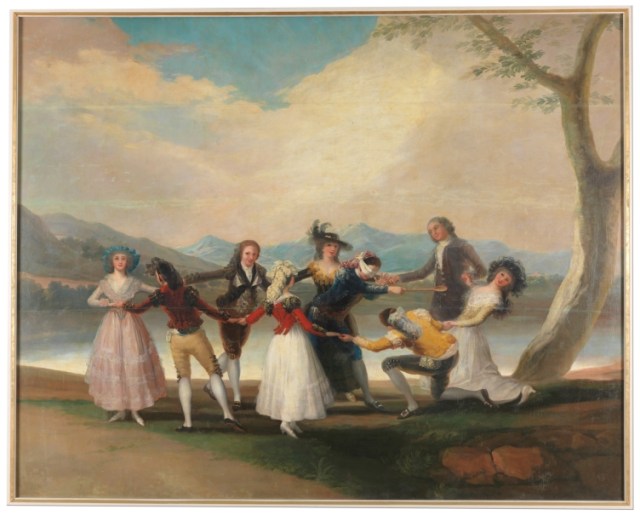
Francisco Goya, 1788
Actually, I haven’t known that many. I’m talking about people who directed offensive remarks at me personally, related to my being Jewish, with intent to hurt. (As to the current variety, who sport masks, they came on scene after I’d left the academy and I can only say that I’m glad I’m not their mother.)
The first was a man with whom Jerry had been friends since graduate school. He’d been a witness at our wedding. He was a priest, at first Roman Catholic but, at the time of this recollection, Russian Orthodox. Since I have a tendency (possibly naïve) to trust men of the cloth – taking them to have deliberately chosen a life with God as their witness – I never felt his vocation as a barrier.
Anyway, not long after we’d gotten married, Jerry and I met this friend for dinner at a restaurant. We were expecting to enjoy a pleasant reunion.
When you meet a trusted friend socially, normally you don’t have an agenda. The fun lies partly in finding out how the conversation unfolds in an unplanned way. So I was surprised to see him bring up modern Israel as the topic to which he’d be dedicating our time together and still more amazed to see him steer the conversation toward a loaded (“have you or have you not stopped beating your wife?”) Israel-baiting question.
I answered in a way that aimed to smooth down the edges of his loaded question. The situation itself had taken me unawares.
It hadn’t taken him by surprise, for he said instantly, “It’s no use talking about this with – an American Jew!”
Historical note: I am clearly a member of the tribe of Jehudah, of which “Jew” is a contraction. You may recall that Jesus said, “salvation is of the Jehudim.” Out of the original twelve tribes of Israel, Jehudah is the only one that survived politically, with Benjamin folded into it. However, my tribal origins aren’t a certainty, since individuals and families from other tribes must have attached themselves to Jehudah after the other ten had been carried off and therefore officially “lost” or dispersed.
Social note: the contraction “Jew” is generally avoided in direct discourse, since one-syllable words sound at least over-familiar or at worst insulting. That’s why polite people will tend to say, “Are you Jewish?” rather than “Say, aren’t you a Jew?” But that’s all I have to report. The further history of the contraction I leave to specialists.
Now back to our three-way dinner at the restaurant. I’ve never known how I should have answered Jerry’s priestly friend. In the moment, what I actually said was … three notes from the bugle …
Nothing!
What a flop! Feminists all over the world are making faces of disgust. I too can’t approve my silence. So what was I thinking? Why didn’t I fight back?
I may have sensed that the insult to me had been aimed at Jerry, but indirectly. Jerry had recently told his priestly friend of having had a religious experience that took Jerry from lifelong agnosticism to faith. At an earlier time, the friend had once confided to Jerry that he suffered deep doubts – is “God” just a projection? – while outwardly continuing to play the part of priest, like an actor on the stage. So it might be that the priest had chosen this rather contemptible way to end the friendship and thereby avoid disquieting comparisons.
Perhaps I sensed that some murky evasions lay back of the aggression outwardly aimed at me. Before you get into a fight, you want to know where your target is to be found. Also, I had an intuitive reluctance to provoke two men into a fight with a woman in the middle.
So I kept silent and, after a pause, retreated to the women’s room. In my absence they had continued chatting though Jerry later raised objections to his conduct via email. On his side he drove the wedge deeper and … we never met again. If that had been the aim, Jerry’s ex-friend the priest achieved it.
Sad, eh?
My second example occurred at an academic conference devoted to the French Jewish philosopher Emmanuel Levinas. It was held at the University of Chicago, with many panels and a large attendance. To my amazement, most panelists stepped around the fact that Levinas wrote as a committed and believing Jew, who argued openly for the relevance and precision of the Jewish understanding of human reality, at the same time openly contesting the Christian alternative views. Of course, that’s what philosophers do, but – given two thousand years of Christian supersessionist doctrine – this plain invitation from Levinas to his counterparts to duke it out in the open like philosophers took great moral and intellectual courage. At the U of Chicago conference, what panelists seemed to want was to savor Levinas’s conclusions without climbing the intellectual ladder he’d provided to get there.
I found the whole event pretty strange, but only offered a counter-argument privately to one panelist after he’d stepped off the stage. To him I reviewed the longer 20th century chronology that I believed would put his conclusory anti-Israel remarks in a relevant context.
How did this panelist respond? He told me that my remarks were evidence of certain defects, moral, emotional and psychological, that were visible –
on my face!
Now Levinas writes a lot about the human face and the obligation it places on people to see the face of the other and respond to it with ample recognition and responsibility. So his use of that term as an insult was remarkable in a Levinasian context. But with or without Levinas, there’s probably no woman on the planet who wouldn’t feel the insult of what this man said.
It was an erotic erasure.
I’m a pretty sensitive girl. To me, it felt like an earthquake. When I reported the incident to Catherine Chalier, the person at that conference personally and philosophically closest to Levinas, I asked her,
“Was there something I should have said?”
“No,” she responded. “It’s hatred. And it’s hopeless.”
There is a chivalry of human relations and it is to be respected. This man had disrespected that chivalry. When, at the finale of his Divine Comedy, Dante writes of love that it “moves the sun and the other stars,”
I think he means
chivalric love.
Related Content: Where’d My World Go?

