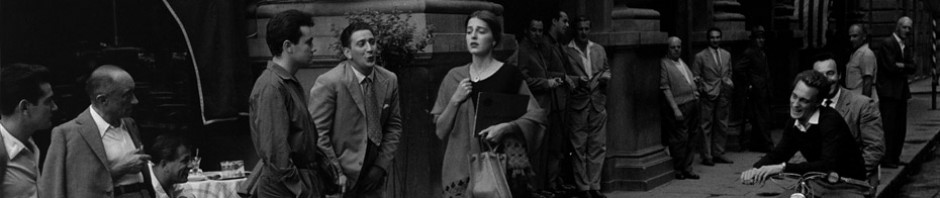

Don Quixote followed by Sancho Panza.
Honoré Daumier c. 1860s.
When someone speaks of satanic attacks, there are of course two questions: (1) Do such events or actions ever actually occur? And, if yes, then (2) was what occurred an event or action of that kind?
The answer may depend on one’s initial worldview – or else on some particular experience that one has had. My own initial worldview would have excluded such happenings. But then certain things occurred within my experience for which the term “satanic” seemed – not exactly clarifying – but more in tune with the actual experience than were the more acceptable labels. One does want to go back to the experience, and keep it in view, to make sure that the purported explanation fits what actually happened.
No sophisticated philosopher I know believes in satanic attacks. Or at least none who might entertain such a belief would be likely to say so publicly. Which is too bad when one remembers the precedent of Galileo. After he was condemned by the Inquisition for holding the then-heretical Copernican view that the earth moved around the sun – and after he had recanted and publicly renounced that view – he is reported to have muttered, under his breath,
All the same, it does move.
Anyway, that’s how I feel about satanic attacks.
*. *. *
We spent last week in California where we go periodically for an innovative treatment that we hope will mitigate my neuropathy. Some patients who go to that clinic report dramatic results in one session. The clinic’s director, the creative innovator – the “genius” of the treatment offered there – has had results that have persuaded the well-regarded hospital hosting his treatments to expand the facilities made available for his work.
With me so far, improvements have been modest at best. But such improvements are better than the predictions of a wheelchair-bound future proffered by the neuropathy specialists whom we’d consulted previously. All this is background to the concerns of the present column.
Among the director’s capable and growing staff is one member who has been with him from the start of the clinic and whom he treats as a quasi-partner – sharing with him ideas and techniques as they evolve. He is also the one member of the team who treats me when the director is unavailable. Let’s call him Ned. Unhappily, Ned often shares his more downbeat view of my prospects, in contrast to the optimistic view taken by his boss. As Ned tells it, the creative director lives in his own world, has his head in the clouds, gets carried away by his own speculative ideas to the point that sometimes he can’t or won’t see the ground underfoot. And Ned’s put-down view had at least been consistent with the outcome of my August treatment – from which I came home more at risk of falling than I’d been before.
However, this time the creative director had a credible explanation for what had gone wrong the previous time. As a result, he had revised the treatment process, was taking before-and-after measurements that were confirmatory of his present approach, and now gave me a detailed explanation of the newly-revised process.
So I had only the final Friday to get through with Ned – and that was the day reserved for teaching me the newly-revised homework. How much harm could Ned do?
Well, I had underestimated him. For most of the two hours he held off teaching me the rather complex new homework – instead going on with ordinary treatment as if teaching the new stuff had not been the main assignment on his agenda. Along with the ordinary treatment, Ned delivered his views on a medley of topics – views that were uniformly depressive. Since I don’t like to regard human life in a discouraging way, I found myself working to mitigate each of his gloom-and-doom descriptions-with-attached-predictions.
Finally, for the last quarter hour, Ned began to teach me the new home exercises. They turned out to be of an unprecedented complexity. When I expressed worry and surprise at the unexpected difficulty of them, Ned was curt, telling me in effect to shape up and do so in a hurry if I wanted any help from him.
However, Ned the drill sergeant simply disappeared toward the end of the session – when Jerry showed up to collect me. With Jerry looking on, one saw a new Ned – compassionate, reassuring, soothing, gentle and sensitive. Golly gosh. Turns out everyone finds the new homework difficult! Normally a number of sessions get devoted just to learning its complex components. I should just do as much as I can. I shouldn’t worry. In time, it will all come together.
No one I know – no ordinary person who is not an actor – can switch bodily posture, style of language, tone of voice and facial expression – all in less than one minute.
The contrast between the devilish nobody-can-see-me Ned and the angelically patient-and-benevolent-healer Ned was too stark for anybody who had seen both versions to miss. So it’s likely that Ned never expected me to share with my husband my experience of the two Neds.
*. *. *
Of course, once we were alone, I did tell Jerry what I’d just experienced. Although less likely than most people I know to rush to dramatic conclusions, Jerry volunteered that Ned may yet try to undermine his boss by going to higher ups in the organization with a report of some manufactured malfeasance made up out of whole cloth by Ned.
Supposing Jerry’s conjecture to be at least credible, I would very much like to warn the creative director. But a warning based on conjecture of this kind would be likely to have no effect except to harm me. A patient’s intuition is not evidence and suspicious changes of tone and conduct can easily be explained away.
What conclusion can I draw? As of now, if I’m right about the co-worker in whom the creative director has placed his trust, there is nothing I can reasonably do about it. That is, nothing but wait. In time perhaps, an opportunity to prevent mischief might present itself or else – unfortunately –
it might not.

“Satan” always seems too grandly poetic a figure. In Paradise Lost, he is the greatest of angels, overcome with pride and hence falling to earth, which is his new dominion. My grandmother had it about right when she talked about some mean kid getting into trouble or her wayward grown son up to no good: “the devil got into him.” That “devil” sounds not so much like lord of a fallen world as an impish creature who seizes a person’s motivational strings and maliciously pulls them in all the wrong directions. It is amazing how much harm such a “little” creature can do!